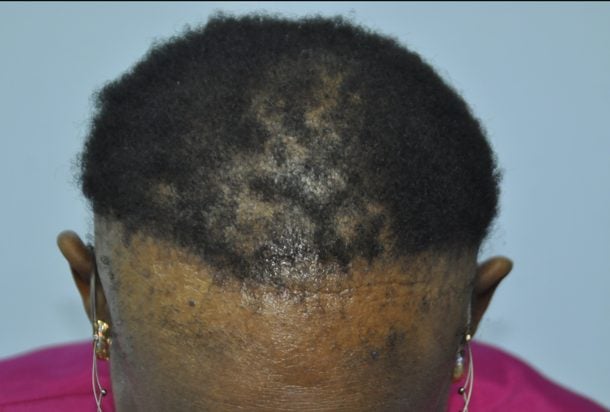

Almost every week, someone sits at the clinic and tells me their hair has stopped growing or doesn’t grow as long as they wish it to.
What I find happening is that the hair is growing and breaking before anyone can see the length, or a shed that started months ago is only now becoming visible, or the growth is there but slower than the expectation the person arrived with.
I teach trichology students in training, and we begin with the hair growth cycle for a simple reason. Almost every question a person has about their hair, from why it sheds in the shower to why it will not grow past their shoulders, is answered by understanding the cycle each hair follicle is running on.
The single most common misunderstanding about hair growth that walks into the clinic is the belief that hair growth is solely determined by the products we use. That having a shelf full of products claiming to grow your hair is the ultimate hair growth hack. This cannot be further from the truth.
Your follicles were all counted before you were born
Hair follicles are not something the body keeps making. They form while we are still in the womb, beginning around the ninth week, and the full set is complete before a baby is born.
After that, the number is what it is. New hair follicles do not form after birth, although new hair keeps growing from the follicles we already have.
This one fact changes the whole conversation at the clinic. You can’t buy more follicles, so the work is never about adding them, it is about protecting and supporting the ones you already have.
It also explains why the size of a follicle matters so much. A follicle can produce a thick, pigmented hair for years and then start producing something finer and shorter, and that is what thinning looks like at the level of one follicle. This is the difference between vellus and terminal hairs.
The four phases every hair moves through
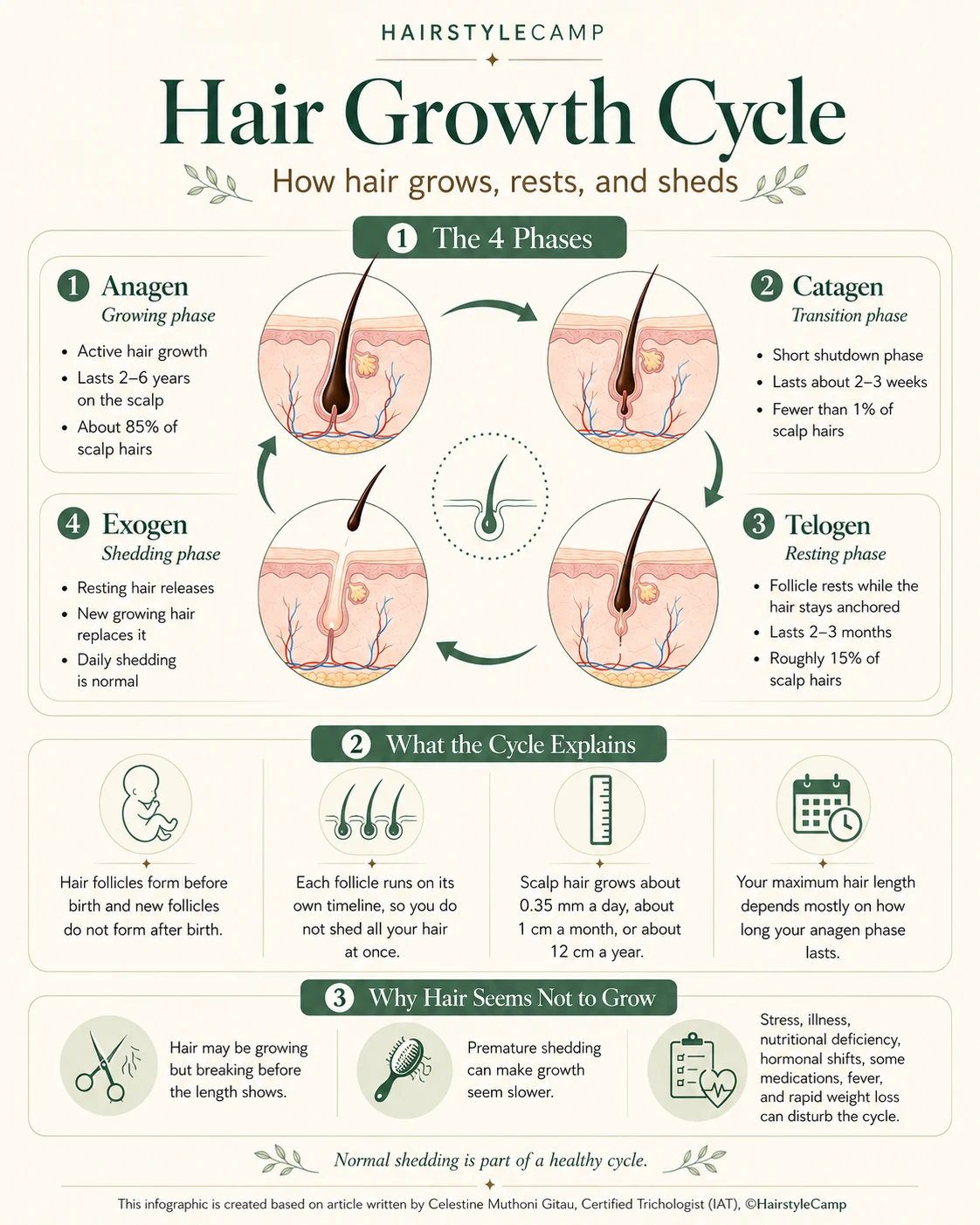
Each follicle works through a repeating cycle, and it does so independently of the follicles around it. There are four phases, and once we understand them, almost every hair question becomes easier to answer.
Anagen, the growing phase
This is the active phase, when the follicle is genuinely producing hair. It lasts two to six years on the scalp, and at any moment about eighty-five percent of your scalp hairs are in it.
The length of your anagen phase is largely inherited, and it is the single most important aspect in this article. I will come back to why.
Catagen, the transition phase
This is a short, tidy shutdown. Catagen lasts about two to three weeks, and fewer than one percent of scalp hairs are in it at any time. The follicle stops producing hair and begins to regress.
Telogen, the resting phase
The follicle now rests, typically for two to three months, while the hair stays anchored in place. Roughly fifteen percent of scalp hairs are resting at any moment.
Nothing is wrong during telogen. A resting follicle is a normal follicle waiting for its next turn, and it is holding onto a finished hair until that hair is ready to let go.
Exogen, the shedding phase
Finally the resting hair releases. Exogen is the ordinary daily shed, described as the loss of twenty-five to one hundred hairs that are replaced by new growing hairs.
The hair does not grow all in tandem. Some hairs are growing while some are transitioning and shedding, which is completely normal. It explains why every day when you comb your hair you see some hairs on your brush.
Why you do not shed all your hair at once
Each of your follicles runs its own timeline. Some of your hair may be two years into growing while others are three weeks into resting.
That independence is the reason a healthy scalp sheds a little every day instead of molting in seasons, and it is why losing a few hairs in the shower is usually a sign of a working system rather than a failing one.
It also tells you something useful in reverse. When shedding suddenly becomes heavy and noticeable across the whole scalp, it often means a large group of follicles was pushed into resting prematurely at the same time, which points to a single event some 2-3 months earlier. We call events that cause this excessive shedding stressors and could be anything from seasonal changes, deficiencies, fever, psychological stress, or any other event that pushes the body out of its normal state.
How fast hair actually grows
Scalp hair grows at roughly 0.35 millimeters per day, which works out to about one centimeter a month, or roughly twelve centimeters in a year.
That number is worth sitting with, because it is the arithmetic behind most of the disappointment I see. Going from a chin-length bob to mid-back hair is not a six-week project, it’s a two to three year one.
It also explains why the regrowth questions have such predictable answers, whether a client is asking about regrowth after shaving or a hair that was plucked out with its bulb.
Growth rate does slow over a lifetime. Both growth rate and hair density decrease with age, and that is part of why hair in our fifties behaves differently from hair in our twenties.
The length ceiling nobody explains
This is the one concept I most wish everyone knew. Your maximum length is not a matter of effort, it is set by how long your anagen phase runs.
If your growing phase runs about three years at a centimeter a month, then your hair will stop somewhere around thirty-six centimeters, and no product will change that ceiling.
So the woman with waist-length hair is not doing something you are failing to do. She simply inherited a longer anagen phase, and that is all it is.
There is one important qualifier. Most people never reach their true ceiling, because hair breaks or sheds before it gets there. When someone tells me their hair will not grow past a certain point, the honest answer is usually that it could be growing fine and being lost at the ends or is shedding prematurely.
During assessment, I look for signs such as split ends and damaged hair shaft, which tell me that the hair is breaking rather than shedding. When the hair shaft is brittle or fragile, we get breakage, which keeps eating into the length of the hair. Split ends as well run down the hair strand, eventually snapping off and taking away the length with it.
Shedding: however we see hair coming off from the root, mostly with a white speck on one end. That white speck is the club root, the sealed tip of a resting hair; the follicle itself stays in the scalp, ready to grow again.
Normal shedding, and the shed that means something
It is normal to shed between fifty and one hundred hairs a day. Most people never notice this, until something makes them look.
What I look for at the clinic is not the count, which almost nobody measures accurately, but the change. A shed that is heavier than your normal, and lasting longer than a few weeks, is the one worth paying attention to.
The timing is the most useful clue, and it is the part people rarely know. When a large group of follicles is pushed into resting early, the hairs do not fall immediately, and the shedding generally appears two to three months after the trigger.
So the illness, the surgery, the birth, the crash diet, or that season of real strain is usually already behind you by the time the shedding starts. Clients almost always blame whatever they did last week.
The reassuring part is that this kind of shedding is usually self-limiting, and the large majority of acute cases settle once the trigger has passed or has been resolved. That said, a shed that keeps going, comes with scalp pain or scaling, or appears in distinct patches is something to have looked at by a dermatologist or a trichologist rather than waited out.
Even as you monitor the shedding, it gets to a point where it is no longer something to wait it out and becomes something worth an appointment.

If shedding lasts more than 6-12 weeks after the stressor has passed, I would highly recommend that you have it checked out.
Some causes of excessive hair shedding, such as nutritional deficiencies or hormonal shifts, need to be resolved so that the shedding can stop.
It’s during the appointment that a hair specialist would pick some of these causes that may not be self-limiting, work on correcting them, and only then do we expect to see a reduction in shedding.
What actually shifts the cycle
When the cycle is disturbed, the cause is usually systemic rather than cosmetic. The list we work through at the clinic includes thyroid disorders, iron deficiency, hormonal shifts including postpartum and menopause, rapid weight loss, certain medications, illness with fever, and sustained psychological stress.
Notice what is not on that list. Your conditioner, your brush, and how often you wash are rarely the reason a cycle shifts, although they matter a great deal for whether the hair you grow survives long enough to become length.
Pattern thinning works differently, and it is worth separating clearly. In androgenetic thinning, androgen receptor activation shortens the anagen phase over successive cycles, so each new hair is a little finer and a little shorter than the one before.
That is why it looks like gradual thinning rather than sudden shedding. The follicles are still working, they are simply making smaller hair each time around, and this is a pattern a dermatologist or a trichologist should assess rather than something to manage alone.
In my practice, the most common causes of disturbed hair cycles that I actually diagnose are psychological stress and nutritional deficiencies. Vitamin D, iron, and ferritin levels are the most common that I come across. With the rise of fad diets, this has become such a common phenomenon.
Clients mostly do not expect this to be the case. They always attribute the shedding to a hair product they used or a hair routine they were into.
Textured and coily hair: what the cycle looks like in my clinic
Most of what has been published about hair was not written with African hair in mind, and that gap shows up at the clinic daily.
Follicle density genuinely differs between populations. One trichoscopic study measured roughly 169 to 177 hairs per square centimeter in African American participants against around 280 in Caucasian participants, and that is a normal baseline, not a deficiency.
The follicle itself is curved rather than straight, and that is what produces the coil. That same curve is where the fragility comes from, because every bend in a strand is a point where force concentrates.
This is the heart of the myth that African hair does not grow. Truth is, it grows. It is simply retained less easily, because a coiled fiber is more vulnerable at the ends and scalp oil is slow to travel down it.
The other issue I see constantly is tension. Traction alopecia is estimated to affect about one third of women of African descent who wear high tension styles over long periods, and the risk rises further when chemical relaxing and heat processing is part of the routine.
The guidance I give is refreshingly simple: if a hairstyle feels painful, it is too tight.
Understanding your own pattern helps here, whether that means placing yourself among Type 3 and Type 4 textures, knowing how the 4A, 4B, and 4C patterns behave, or understanding how porosity affects moisture.
It is always a shocker to clients at the clinic once I evaluate them and tell them they lost their hair from tension, and they ask, “But how? I have been doing protective styling for years!” I see hairstyles made using heavy extensions and tight braiding being labeled as protective, and I can’t help but wonder what they are protecting, really.
It’s not protective styling if it’s costing you your hair.
The curls on coily hair make it appear thick and resilient. Truth is, coily hair is way weaker and less resilient, thus very easily damaged by styles, heat, and chemicals. To retain growth, it’s prudent to have that at the back of your mind anytime you think of styling your hair.
Too much heat will damage the hair as well as overprocessing. Damaged hair shafts will break off, and there goes your length. These are some of the aspects that make people with coily hair think that their hair cannot grow long.
It can get to its designated growth length, but only if we eliminate factors that are jeopardizing the growth.
What no product can do, and what good care genuinely does
I want to be honest about the limits here, because the industry rarely is. Nothing applied to the outside of a hair will lengthen your anagen phase, add follicles, or change the diameter your follicle is programmed to produce.
The hair we can see is not living tissue. It can’t be repaired, only maintained, and that is why the language of repair on a bottle is marketing rather than fact.
What good care does achieve is real, and it is not small. It protects length from breakage, keeps the scalp in good condition so the follicles can do their work, and gives the hair you grow a chance to survive long enough to show.
Clients ask constantly about growth oils, rosemary oil, biotin, and hair vitamins and wonder if these are worthwhile in their hair growth routine. If the hair is healthy without loss or scalp conditions, then these are wonderful additions to help support the structural integrity of the hair shaft and also provide a pool of nutritional support for the hair. Oils like rosemary have shown positive outcomes in a controlled six month trial.
But with underlying conditions like deficiencies, structural damage, and the like, this routine might not be enough to resolve the problem.
Do not take biotin specifically for hair growth without a reason to do so. High-dose biotin can interfere with some blood tests; tell your clinician and laboratory about supplements you take.
The truth is biotin has no proven benefit for hair growth in people who are not deficient.
When to see a professional
Self-managing is reasonable for ordinary shedding that settles within a few months. Some situations deserve a trained pair of eyes sooner.
I would encourage anyone to come in if shedding is heavy and persists beyond three months, if the hair is thinning at the crown or the part is widening, if there are bald patches, if the scalp is painful, itchy, or scaling, or if the hair loss followed a new medication or a major health event.
A dermatologist assesses and manages the medical side. A trichologist works alongside that, on the hair and the scalp themselves, and on the daily handling that decides how much length you actually keep. It also helps to tell buildup apart from dandruff, because the two look alike and call for very different responses.
What I wish clients could do sooner is seek professional help. From my experience, the earlier we catch hair loss, the better. Since we only have the hair follicles we were born with and do not grow new ones in our lifetime, ensuring that we protect what we have and limit further loss early enough is an ultimate game-changer.
However, when someone comes in later when the hair loss has progressed, we still do our best to ensure that we do not lose any more hair, support the existing hair, and also look into ways we can help the client recover as much hair as possible with existing hair follicles.
Sometimes, due to systemic changes and shifts in our bodies, this cycle is thrown into disarray, causing excessive hair shedding. The good news is that there is a lot we can do to support the hair back toward its normal cycle.
The hair cycle is as it is to make sure that we have hair on our scalp at any given time. Understanding this perspective will help you appreciate those few hair strands on your comb every morning and not worry about going bald in a few days from it. Understanding that timeline will not give you someone else’s hair, but it will tell you which changes are worth making and which are worth ignoring.