

Disclaimer: This content is for informational purposes only and does not constitute medical advice. For sudden shedding, patchy loss, scalp pain, or scaling, please consult a licensed dermatologist.
Noticing a bigger forehead when you look in the mirror can instantly make you stress about losing your hair. But just because your hairline shifted a little higher doesn’t mean you are going bald.
An upward shift in the hairline usually follows one of two patterns: a mature hairline or a receding hairline.
If your hairline shifted due to maturing, it is completely normal and there is no need to worry. A maturing hairline adjusts and stabilizes automatically. But a receding hairline will continue moving backward.
In this guide, you will learn the difference between these two patterns and how to easily tell them apart by their shape and symmetry.
Summary
- Mature hairline: moves back evenly, still looks tidy.
- Receding hairline: temples move back faster, often creates an M shape.
- Best haircuts for mature hairline: crew cut, buzz cut, short side part.
- Best haircuts for receding hairline: French crop, textured fringe, short Caesar.
What Is a Mature Hairline?
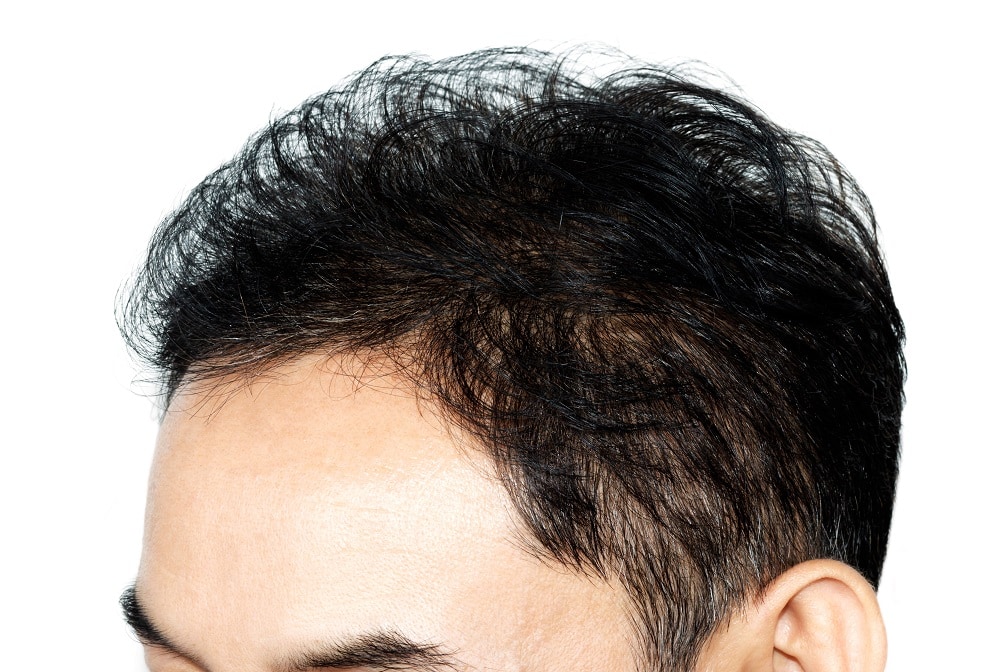
A mature hairline is a normal shift in the hairline as you move out of your teen years and into adulthood.
Visually, the hairline tends to move back evenly. The front line still looks clean and the corners do not cut back sharply.
For many men, it happens gradually. It can be subtle, which is why people often don’t notice it until they compare photos.
What Is a Receding Hairline?
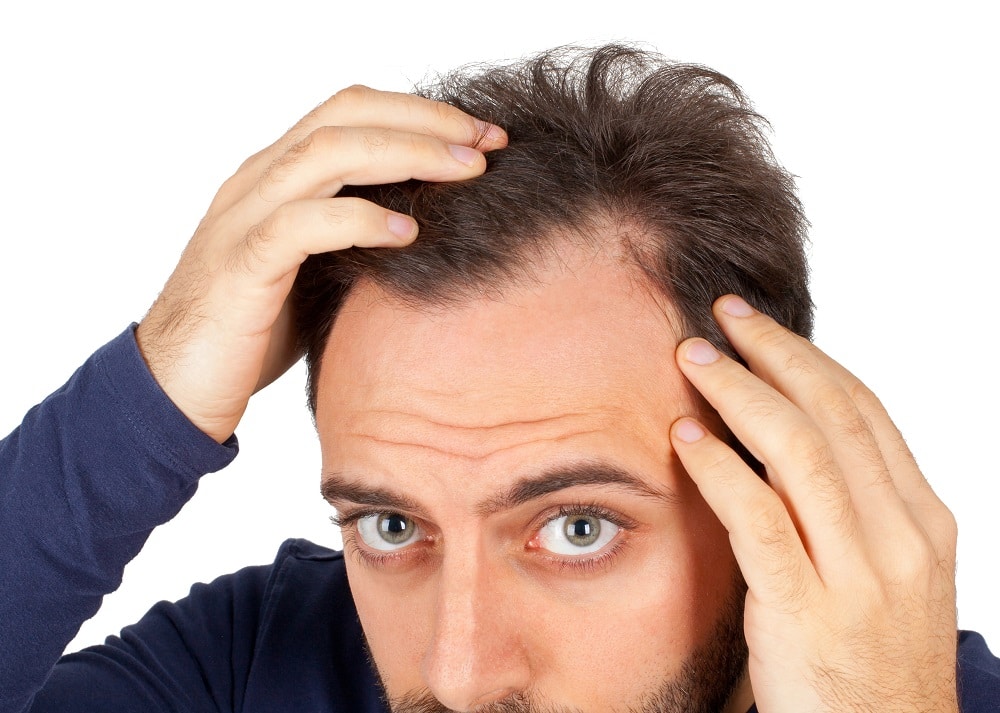
A receding hairline looks different because it is not even. Visually, the temples sit further back than the center. Over time, this often creates an M shape or a deeper “corner” look.
Some people also notice the front corners look lighter or less dense than the middle. That contrast is what makes recession feel more obvious.
What Does Mature Hairline and Receding Hairline Look Like?
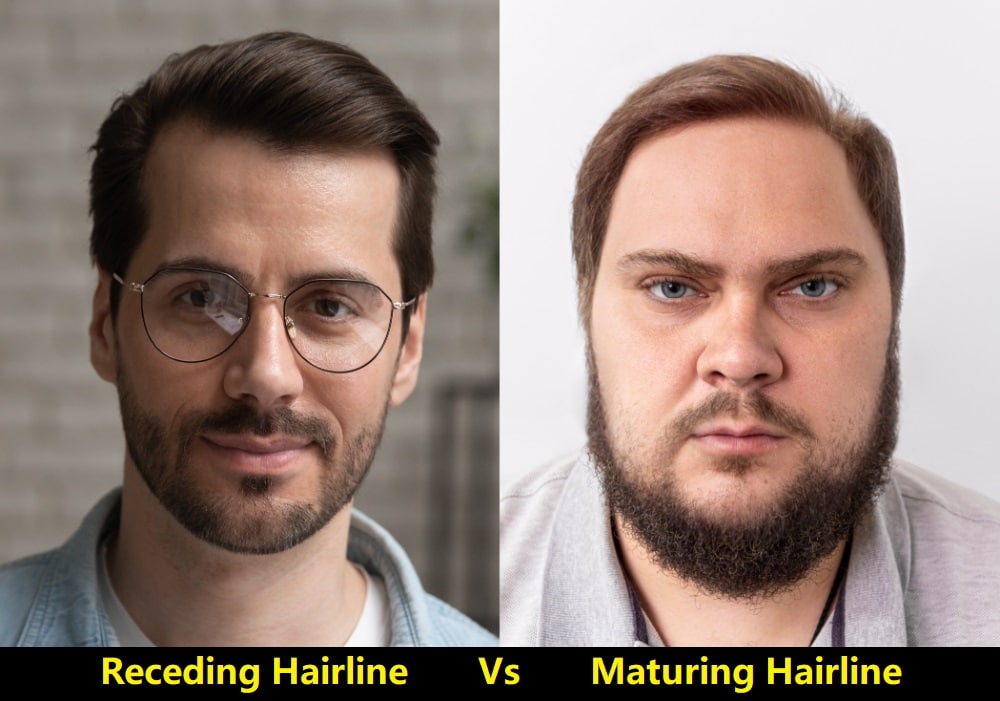
Think of this as straight line versus cut-in corners.
A mature hairline usually looks like an even move back. The outline stays fairly straight or gently rounded.
A receding hairline usually shows more change at the temples than at the center. The corners look deeper. The outline looks less even.
Want a quick mirror check? Pull your hair back and look at both temples. If one side looks more “cut back” than the other, that points to recession rather than a simple mature shift.
Differences Between Mature and Receding Hairlines
Here is the simplest way to separate them.
Mature hairline: even movement, tidy outline, usually settles after a gradual shift.
Receding hairline: uneven movement, deeper temples, outline often becomes an M shape.
The following table summarizes the key differences in a lifestyle-safe way.
| Difference | Mature Hairline | Receding Hairline |
| Visual shape | Even, straight or softly rounded | Uneven, deeper temples, often M-shaped |
| Where change shows first | Front line shifts back evenly | Temples shift back faster than the center |
| Best haircuts | Buzz cut, crew cut, short side part | French crop, textured fringe, short Caesar |
| Styling focus | Clean edges, balanced shape | Texture at the front, softer corners |
| Low-effort maintenance | Regular trims to keep the outline sharp | Texturizing powder or matte paste to add bulk |
Why Does Your Hairline Change?
Hairlines change as you age. Some shifts are small. Some are more obvious. Genetics also plays a role in how your hairline looks over time.
From a styling point of view, what matters most is the outline you see in the mirror and how you cut around it.
Scalp Inflammation Can Mimic Recession
If the hairline area is red, itchy, sore, or flaky, treat that as a scalp issue, not just “aging.”
Common causes include seborrheic dermatitis (dandruff), psoriasis, or irritation from harsh products. Inflammation can increase shedding and can make the hairline look thinner than it really is.
Caution: If you have dandruff or a greasy, flaky scalp, avoid leaving heavy oils on the scalp for long periods. Oils can make flaking feel worse for some people. If you use oil, keep it brief and shampoo it out.
If symptoms keep returning or the scalp is painful, a dermatologist can check for inflammation and recommend evidence-based options.
Traction Alopecia Can Look Like Recession
If you have Type 3 or Type 4 hair, recession at the edges is often from tension, not just genetics.
Tight braids, tight buns, ponytails, heavy extensions, weaves, and aggressive edge styling can slowly thin the hairline. The giveaway is often more thinning at the edges than the crown.
Low-tension styling and breaks from tight looks matter here. If you catch traction early, you often protect more density.
What To Do if My Hairline Is Maturing?
If your hairline is maturing, you usually do not need to “fix” it. You just need a haircut that suits the new outline.
These styling moves help most people right away:
- Go shorter. A crew cut or buzz cut makes the hairline look intentional.
- Ask for clean edges. A tidy shape reads sharper than a longer, soft perimeter.
- Try a side part. It breaks up the straight-on view of the hairline.
What To Do if My Hairline Is Receding?
If your hairline is receding, styling can make a big difference in how the temples look.
Start with haircut choices that reduce contrast:
- French crop. A short fringe softens the corners.
- Textured fringe. Texture breaks up scalp show-through at the front.
- Buzz cut. Removes the “thin versus thick” contrast completely.
Avoid slick-back styles. They expose the corners and they can pull on weaker hairs.
Low-contrast color also helps. Very dark hair on light skin can make recession look harsher. A softer shade or subtle highlights can make the hairline look less “cut in.”
For styling, use a small amount of matte paste or texturizing powder at the front. Keep it light. Too much product makes gaps stand out.
Can I Have a Maturing Hairline at 20?
Yes. Many people see small hairline changes in their late teens and early 20s.
The key is the outline. If it looks even, it often reads as a mature hairline. If the temples look sharply cut back, it can read as recession.
Mature Hairline vs. Male Pattern Baldness
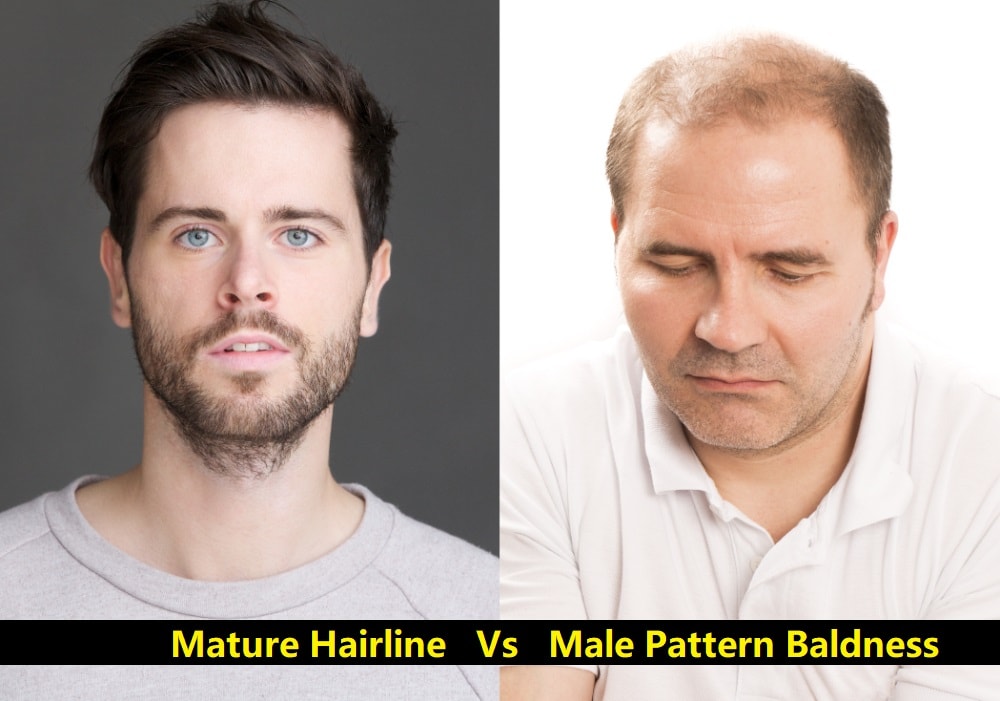
A mature hairline is a normal shift in the hairline as you move out of your teen years and into adulthood.
Visually, it tends to move back evenly. The front line still looks clean. The corners do not cut back sharply.
For many men, it happens gradually. Then it settles. It can be subtle, which is why people often miss it until they compare photos.
Male pattern baldness is different. It is a progressive pattern of thinning. The hairs slowly become finer over time. The pattern often shows at the temples and the crown.
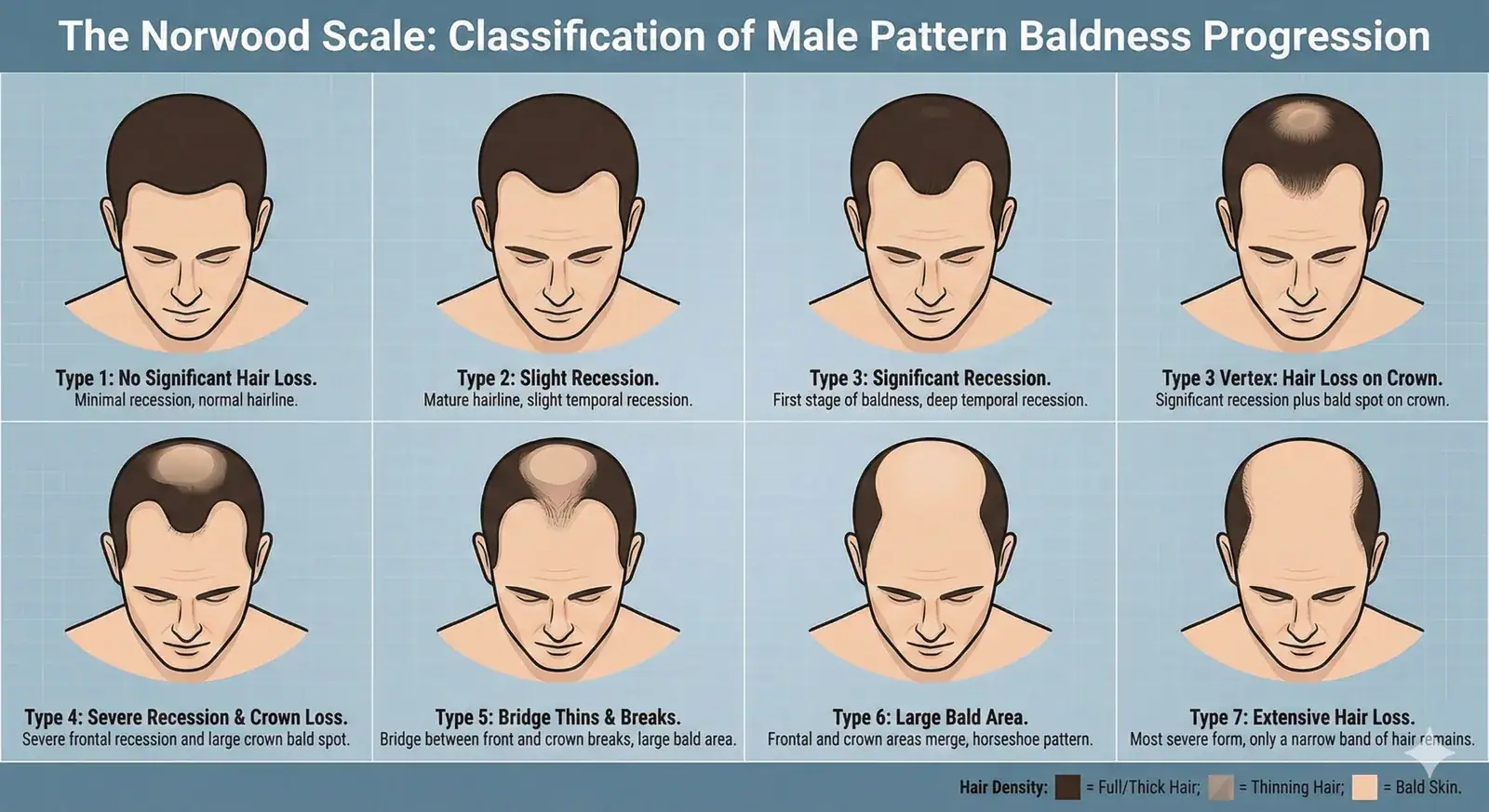
The Norwood scale is a visual chart used to describe male pattern baldness. It tracks recession at the temples and thinning at the crown. It helps you describe what stage your pattern looks closest to.
The Core Difference: Stable vs. Progressive
Think of it like this. A mature hairline is a one time adjustment. Male pattern baldness keeps moving.
- Mature hairline: changes, then stabilizes.
- Male pattern baldness: keeps progressing year after year without treatment.
What You Usually See With a Mature Hairline
- Even shift: the hairline moves back in a balanced way on both sides.
- Clean front edge: the hairline still looks defined, not wispy.
- Good density behind the line: hair right behind the hairline stays strong.
- No crown story: the top and crown usually look the same in photos.
What You Usually See With Male Pattern Baldness
- Temple plus top pattern: recession at the corners, thinning on the mid scalp, or a thinning crown.
- Less density: the hair behind the hairline starts to look lighter and more see-through.
- Finer strands: hairs become thinner in diameter over time. This is called miniaturization.
- Slow drift: the pattern keeps changing, even if it is slow.
| Feature | Mature Hairline | Male Pattern Baldness |
|---|---|---|
| What it is | Normal hairline maturation | Androgen driven pattern thinning |
| Speed | Changes, then settles | Progressive over years |
| Temple corners | Soft, even recession | Often deeper recession, can be uneven |
| Crown | Usually not affected | Often involved over time |
| Hair behind hairline | Stays dense | Gradually looks thinner |
| Hair shaft thickness | More uniform | More mixed thickness from miniaturization |
| Best confirmation | Photo tracking over months | Derm exam, trichoscopy can spot early changes |
Simple Checkpoints You Can Use at Home
Use the same lighting and take photos every 3 months. Do the front hairline and the crown. Most confusion clears up with consistent photos.
Skip “finger tests” that measure forehead height. Foreheads vary. They can mislead you.
Instead, check for miniaturization. Look for thin, wispy, “peach fuzz” hairs mixed with thicker terminal hairs along the temples. A higher share of wispy hairs can be an early sign of pattern thinning.
- If the crown is thinning: that leans toward male pattern baldness.
- If the part line looks wider over time: that also leans toward male pattern baldness.
- If the hairline moved back a bit and then stopped: that can fit a mature hairline.
If you are unsure, a dermatologist can examine the scalp and use trichoscopy. This can help separate normal maturation from early male pattern change.
Tips to Protect Your Hairline
These are safe, practical habits that support hair and scalp comfort. They are not treatments.
Choose low-tension styles
Repeated pulling from tight styles can stress hair at the hairline. If you wear buns or ponytails, keep them loose and change the placement often.
If you wear braids, loc styles, weaves, or extensions, pay attention to the edges. Soreness is a warning sign. Loosen the style or take a break.
Keep the heat controlled
Excess heat can make hair look more fragile. Use lower settings and a heat protectant. Healthy hair looks fuller when it is not dried out.
Massage with care
If you massage your scalp, use your finger pads, not your nails. Keep pressure light. Avoid aggressive scalp brushes on the hairline. The edge hairs break easily.
Style for illusion
If your temples look sparse, texture is your friend. A matte product and a forward style can hide more than a slick-back ever will.
Know when to see a dermatologist
If you notice rapid change, patchy loss, or scalp symptoms, book a dermatology visit. That is the right lane for diagnosis and treatment planning.
- Red, itchy, flaky hairline that keeps coming back
- Patchy loss or sudden shedding
- Eyebrow thinning along with hairline recession
- Smooth, shiny skin where hair used to be
These signs can point to conditions beyond standard pattern loss, including inflammatory scalp disease or scarring alopecia such as frontal fibrosing alopecia (FFA). Early evaluation matters because scarring types can cause permanent loss.
FAQs
A mature hairline usually shifts back evenly and stays fairly tidy. Many people notice a small change over a few years, then it settles. If you are worried about rapid change or patchy loss, consult a dermatologist. For medical guidance, see the American Academy of Dermatology and the NHS.
Hairlines can change with age, and genetics can influence the outline over time. This guide focuses on the visual pattern and haircut choices, not medical causes. If you are concerned about hair loss, see a dermatologist or read the NHS and AAD overviews.
These terms describe how the hairline looks, not a medical diagnosis. A mature hairline often looks even. A receding hairline often shows deeper temples and a less even outline. If you are worried about ongoing thinning, consult a dermatologist. Start with the American Academy of Dermatology and NHS hair loss guides.
Related Topics