


You had highlights done before, and now your roots need a touch-up. But how can you color the regrowth without ruining your existing highlights?
Senior stylist Emma Baxendale protects highlights with judgement first and product second:

I have no special method for protecting highlights when I'm doing a regrowth; I trust my own judgement on placement. If I want to be extra cautious in an area, I put some conditioner on a brush and apply it where the highlights start, to create a protective barrier.
The hairline is always something I paint first; those hairs can be the most stubborn for grey coverage. And timing doesn't change: the color always needs its full development time from when it has been applied all over.
How to Protect Highlights When Coloring Hair
There are a couple of options when it comes to touching up your regrowth without ruining the highlights.
Option 1
When you want to touch up your regrowth but wish to protect your highlights, you can actually just apply the color over the regrowth. Do this with a hair color brush very carefully.
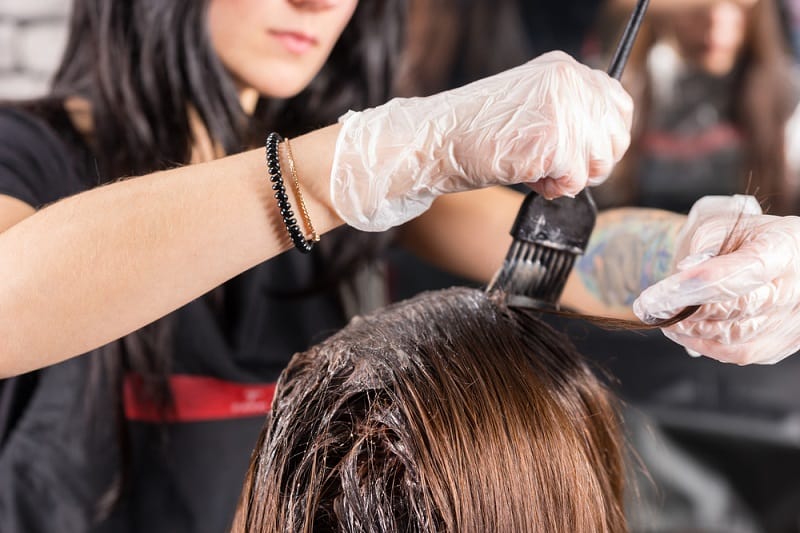
Firstly, divide your hair into 4 sections.
Secondly, start at the front hairline, because gray there is often the most stubborn spot for coverage, then section the rest of the head and work through it. The exception: if your hairline has a history of grabbing color too dark, save those fine, porous baby hairs for the last 5-10 minutes instead. Cover just the hair that requires recoloring, without overlapping onto the previous color.
Thirdly, start with the parting and work from the back of the head toward the front sections, taking sections of half a centimeter each. When you are sectioning and coloring like this, you need to color both sides of the sectioned piece of hair to ensure good coverage of all of the hair.
When the first front section is completed, move on to the second front section, with exactly the same method. Following the application of the front sections, move on to complete the rear sections as well.
Apply color to the front sections first because these areas often have the most stubborn gray hairs. If gray keeps ghosting through, the answer is a shade formulated for extra coverage rather than simply leaving the color on longer; a good product covers within its normal processing time.
If you’re careful and do not apply hair color over the previous color, there’ll be no need to do anything further to protect highlights! To prevent the dark root color from staining your highlights, coat your highlighted mid-lengths and ends heavily in conditioner, both while you apply the root color (it acts as a barrier) and again before rinsing in the shower.
Tilt your head back to rinse the root color backward so the dark water does not run down the length of the blonde. Don’t allow the new color to remain on the rest of your hair for any period of time to help ensure a clean, even result.
Pro tip: Always go back over the outer hairline, especially if the hair contains gray hairs. Some of these gray hairs are very strong and have a mind of their own. If they have popped out of the color you applied initially, they often will not be colored. And they are very obvious!
Option 2
Another option for protecting the highlights from a new hair color application is carefully picking the highlights up with a tail comb and covering them in foil. This process is a lot more tedious.
However, if you want to change the color that is around your highlights, it’s a very effective way of doing it!
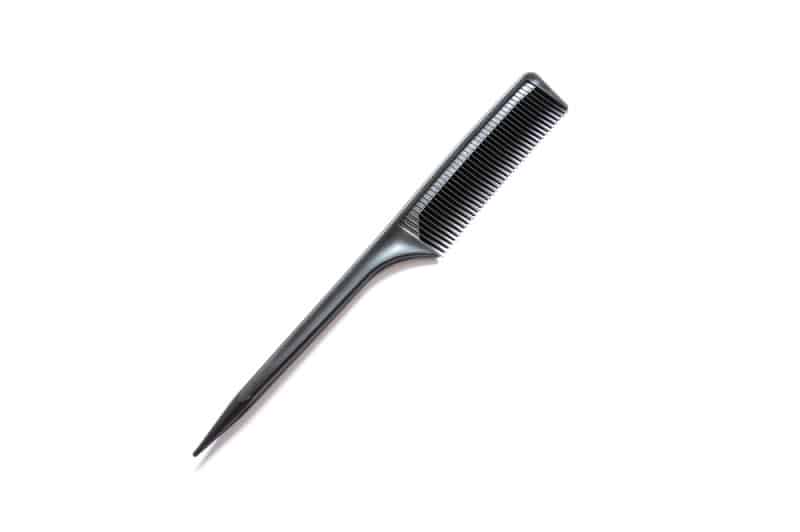
To perform this method, you need a tail comb, hair color bowl, brush, and conditioner.
Firstly, highlights are typically applied in a direction, maybe around the hairline then sectioned back, or from the front of the hairline straight back to the crown and then down the sides. There are a number of different ways to section for highlights.
However, if you can see or remember the direction they have been applied, it will make picking them up with the tail comb easier!
Once you have established the direction you are going in, use your tail comb to push a bent piece of foil underneath the hair you have picked up, then paint the highlighted pieces with conditioner.
Then fold the foil over and over the highlighted hair a few times to securely hold the highlights in place in the foil. If you don’t use conditioner, the hair may spring out of the foils.
Foiling every highlight is thorough but slow; the quicker version of the same protection is to smudge a little conditioner where the highlights begin as you color each section. Either way, once the highlights are protected, you are free to start applying your new color.
Just remember, if you are depositing color in between your highlights, use a gentle demi-permanent color with a low-volume developer (for example, 5-volume or about 1.5%–2%), following the brand’s instructions. This helps minimize cuticle lift and reduces the risk of unnecessary damage or unwanted lightening around your highlights.
Pro tip: Using the conditioner works in two ways. The conditioner makes it easier to contain the hair, while also keeping the cuticle closed and protected.
Option 3
There is actually a third option that can be used to protect highlights, and this is likely the most common option that is used in salons.
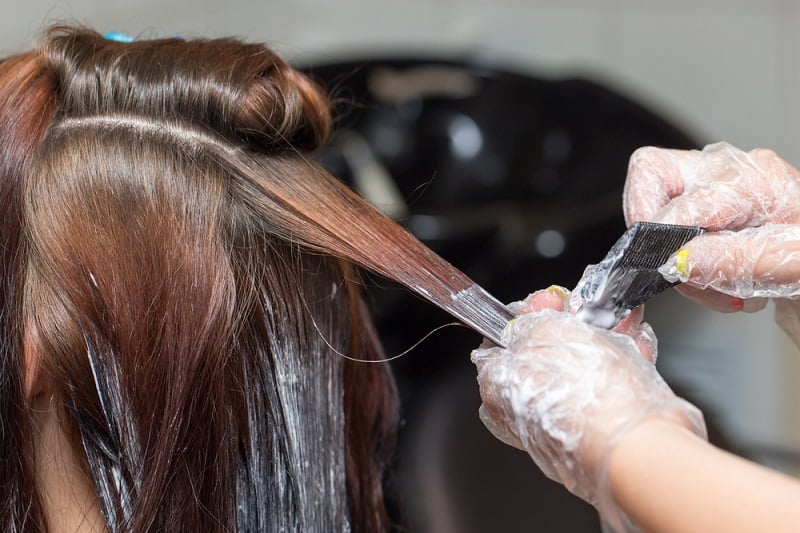
First, the color that is currently on the hair is visually assessed, and a color that is very similar to the darkest shade currently in the hair is chosen.
Pro tip: This is always a different color from what was originally put in the hair because of natural fading and the degree to which the original color has faded because of environmental factors, heat, and treatments used between color applications.
It will also be affected by the hair color and condition of the hair originally. The degree of fading and remaining color pigments will be different for everyone!
Once the appropriate hair color is chosen, follow the same application method described in the first option for protecting your highlights.
However, when you apply the color, instead of applying it only to the regrowth, use a root-smudge technique: apply the root color, then use a clean brush, a wide-tooth comb, or a detangling brush in one gentle downward sweep to feather the color about 1 cm into the start of the highlights. Never use a fine-tooth comb here; it drags color down the lengths and leaves dark spots in the blonde.
Diagram: After applying the root color, gently feather it down into the first ~1 cm of highlights for a soft blend.
The idea is that you are blending your new color into your previous color so that you do not end up with a color line between the two colors. This method graduates the new color into the previous color and “blends” the two colors beautifully!
This method minimizes overlapping damage to your existing highlights, and the blended root can actually accentuate them! The ideal way to finish this root-smudge method is by applying an acidic demi-permanent gloss or toner over the highlights. A two-toner finish blends even more softly: one darker toner to melt the root into the highlights and a brighter one over the lengths, brushed through so nothing spots.
Because these toners sit at a lower pH, they can help smooth the cuticle, making the hair look shinier and the tone more even, without unnecessary lift. This works as a long-lasting refresher that boosts shine and tone while being gentler on lightened hair and less likely to shift your natural, un-lightened base.
Pro tip: This method can be used a number of times before new highlights are required, depending on the look that you are after. When this method is used a number of times consecutively, it starts to create an ombré-to-balayage-type look.