

Hair traits mostly come down to individual genetics, but certain hair characteristics like strand diameter, density, growth rate, and strength often follow distinct patterns based on ethnicity.
If you are wondering which ethnicity has the thickest hair and thinnest hair, we’re here to give you the answers. In short, Asian hair typically has the thickest individual strands, Caucasian hair has the most strands per square centimeter, and African hair tends to be the finest when measured by average strand diameter.
Certified trichologist Celestine Muthoni Gitau answers the title question the way she would for a client:

When strand thickness is measured,the answer depends mostly on ethnicity which is driven by genetic makeup. People of Asian descent will have thicker hair while people of African descent tend to have the thinnest hair. How thick or thin the hair is is not a flaw by itself.
What Are the Major Ethnic Hair Types?
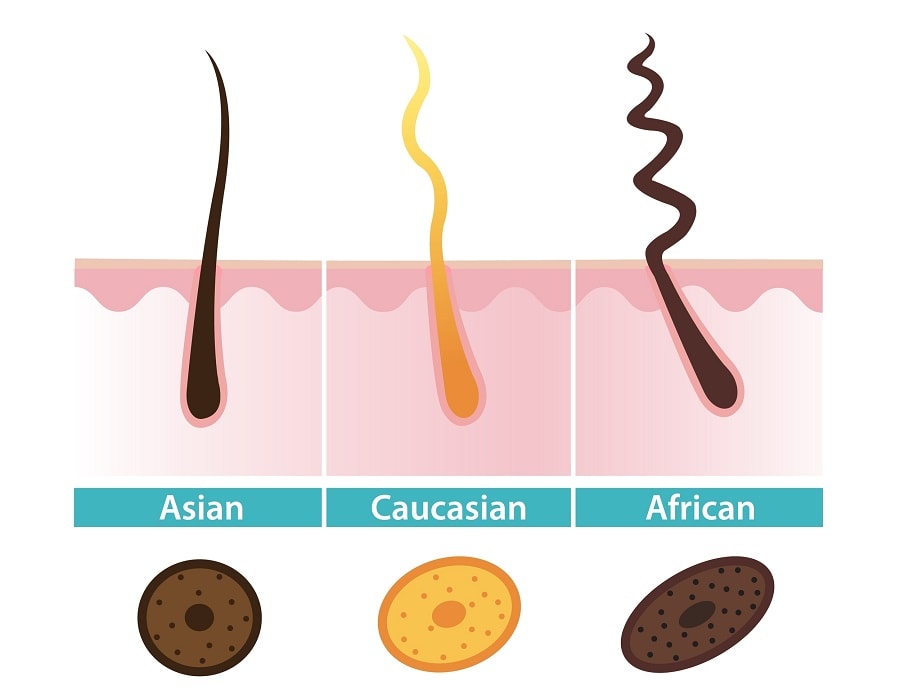
When categorizing hair by ancestry and common traits, there are three major ethnic groups: Asian, Caucasian, and African.
However, these characteristics are not absolute. For example, Asian hair is typically straight, but that doesn’t mean Asian people don’t have curly hair. It just means it’s less common among Asians.
Also, these ethnic groups are incredibly broad. A 2016 global study conducted across 24 different ethnic groups of 2,249 young adults found that East Asian hair (Chinese, Korean, and Japanese) tended to be the thickest on average, with the Chinese group the thickest among those measured, while Indian hair, though thick, tended to be finer than East Asian hair.
So, while these three major categories are helpful guidelines, there is still plenty of variation within them!
Note: These comparisons reflect general averages, not absolute rules.
Which Ethnicity Has the Thickest Hair?

When discussing hair thickness, things can get a little confusing! People often mix up thickness (the width or diameter of a single hair) with hair density (strands per square centimeter on your scalp). So, we will answer for both.
If we are talking about the actual width of a single hair strand, Asian hair is the thickest.
An individual Asian hair strand typically measures 80-120 microns in diameter, making it thicker than African and Caucasian hair strands.
While Asian hair has the thickest strands, Caucasian hair has the highest density. Caucasians have an average of 153 to 299 hairs per square centimeter on their scalps.
Which Ethnicity Has the Thinnest Hair?
When people use the term “thin hair,” they are often mixing up two different things: fine strands (diameter) and low density (hairs per square centimeter). As we’ve seen, these are not the same thing!
African hair is typically the thinnest in both average density and strand diameter. Here is how the three major groups compare:
Individual Strand Diameter (Fineness)
- African hair: 55 microns on average (The finest/thinnest strands)
- Caucasian hair: 65 microns on average (Medium)
- Asian hair: 80–120 microns (The thickest strands)
Scalp Density (Strands per square cm)
- African hair: 111–211 hairs/cm² (Lowest density)
- Asian hair: 121–229 hairs/cm² (Medium density)
- Caucasian hair: 153–299 hairs/cm² (Highest density)
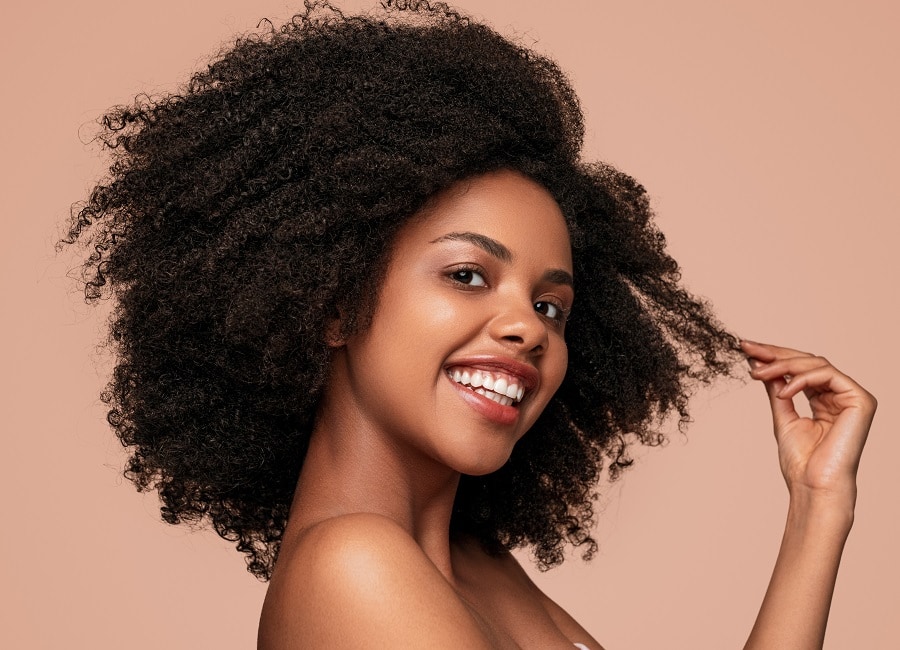
This usually surprises people! If African hair has the lowest density and the finest diameter, why does it often look the most voluminous? It all comes down to the curl pattern and follicle shape.
Even though there are technically fewer hairs on the scalp, the unique structure of the coils creates the appearance of incredible fullness and density.
African hair follicles are highly elliptical or flattened, which creates a tight, coiled structure. The three-dimensional nature of the coils takes up much more physical space than straight hair and looks thicker and fuller.
| Feature | Asian Hair | Caucasian Hair | African Hair |
| Strand Diameter | Thickest (80–120 microns) | Medium (65 microns average) | Thinnest (55 microns average) |
| Scalp Density | Medium (121–229/cm²) | Highest (153–299/cm²) | Lowest (111–211/cm²) |
| Follicle Shape | Round | Oval | Elliptical / Flat |
| Natural Texture | Typically Straight | Straight to Curly | Coiled / Kinky |
So, Which Ethnicity Has the Thickest & Thinnest Hair?
Asian hair is known for having the thickest individual strands, while Caucasian hair has the highest density of follicles on the scalp.
Celestine again, on what strand thickness should change about your care:
Strand thickness is a significant determinant of how hair should be cared for. Someone with thin hair may need gentler care for their hair compared with thicker types of hair to prevent breakage.
African hair is usually the thinnest in both diameter and density, though its unique coiled structure provides incredible natural volume that often makes it appear the fullest of all!
Editor’s Note: To maintain the highest editorial standards, the ethnic hair diameter and density cited in this article are sourced directly from peer-reviewed literature, including the 2016 L’Oréal Global Diversity Study, the Asian Journal of Beauty and Cosmetology, and Clinical, Cosmetic and Investigational Dermatology.