

You may have noticed that Asian people often have darker and straighter hair, while Caucasian people tend to show more variety in color and texture. But the differences go beyond appearance.
Ethnicity plays an important role in our hair’s biology. Asian and Caucasian hair generally differ in structure, thickness, growth rates, and more.
Let’s take a closer look at the common traits of these two ethnic hair types.
Hair 101: Looking Closer At Hair And Ethnicity
As much as we dye, cut, curl, or shave our hair, the fundamental structure is dictated by our genetics. It’s an inherited trait passed down through our families and ethnic backgrounds.
Scientists generally categorize human hair into three major groups based on ethnicity: Asian, African, and Caucasian. According to multiple research studies, human hair shows 8-10 distinct properties based on ethnicity.
The primary ones are:
- Cuticle layers
- Cross-sectional area (width of each hair strand) and density
- Hair curvature and straightness
- Pigmentation (natural color)
- Hair growth rate
- Hydration content
Note: These comparisons reflect general averages, not absolute rules.
The Key Differences: Asian vs. Caucasian Hair
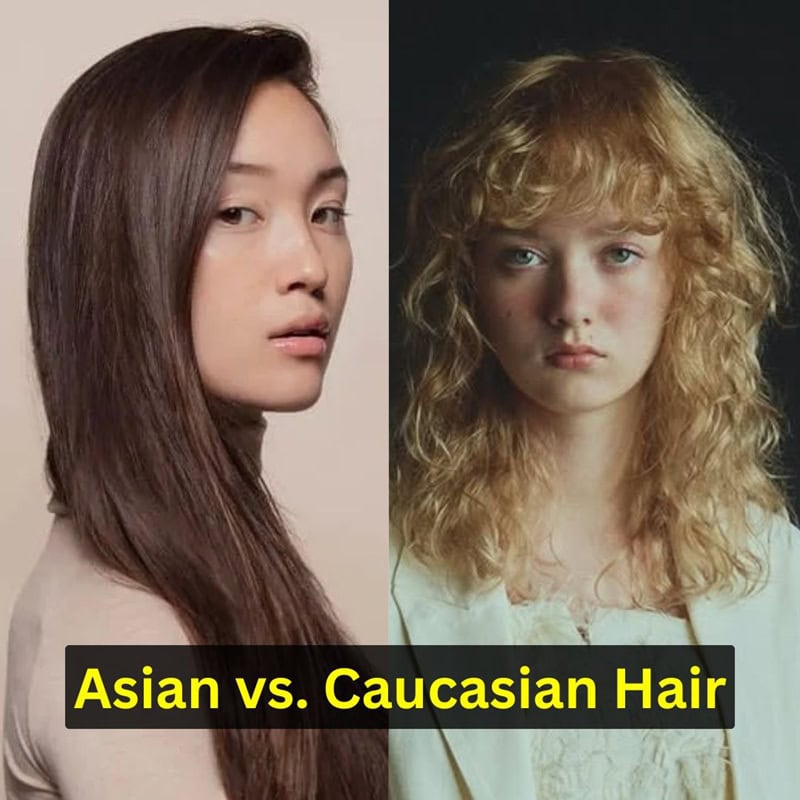
Asian hair is generally darkly pigmented or black, straight, and shiny. It is often known for its thick, smooth, and strong appearance.
Caucasian hair is generally more varied in texture, shape, and color. It can be straight, wavy, or curly, and it shows the widest natural color range.
The unique characteristics of each ethnic hair type are based on averages. These traits are not absolute, as some Asian people can have naturally curly hair, or Caucasian people can have naturally darker hair.
With that in mind, let’s take a look at how common hair traits differ between these two major ethnic groups.
Cuticle Layering
The cuticle is the protective layer of overlapping scales that surrounds the hair shaft. While each cuticle layer is about 0.3-0.5 microns thick in both groups, the total number of layers differs significantly.
According to this research, Asian hair has a higher number of cuticle layers, typically ranging from 6 to 10 (averaging around 7). Caucasian hair usually ranges from 4 to 7 (averaging around 5).
Even though the individual shingles or cell layers are almost the same size for both ethnicities, the higher number of total cell layers gives Asian hair a thicker protective outer shell. This denser structure makes the hair stronger, more compact, and better able to resist damage under stress.
Cross-Sectional Area and Density
Cross-sectional area refers to the size of each individual hair strand, while hair density refers to how many strands grow per square centimeter of scalp.
Asian hair has the widest diameter of the three major ethnic groups, while Caucasian hair typically has the highest hair density.
Curvature And Straightness
Asian hair is more likely to grow in a straight pattern, while Caucasian hair has more natural movement and texture.
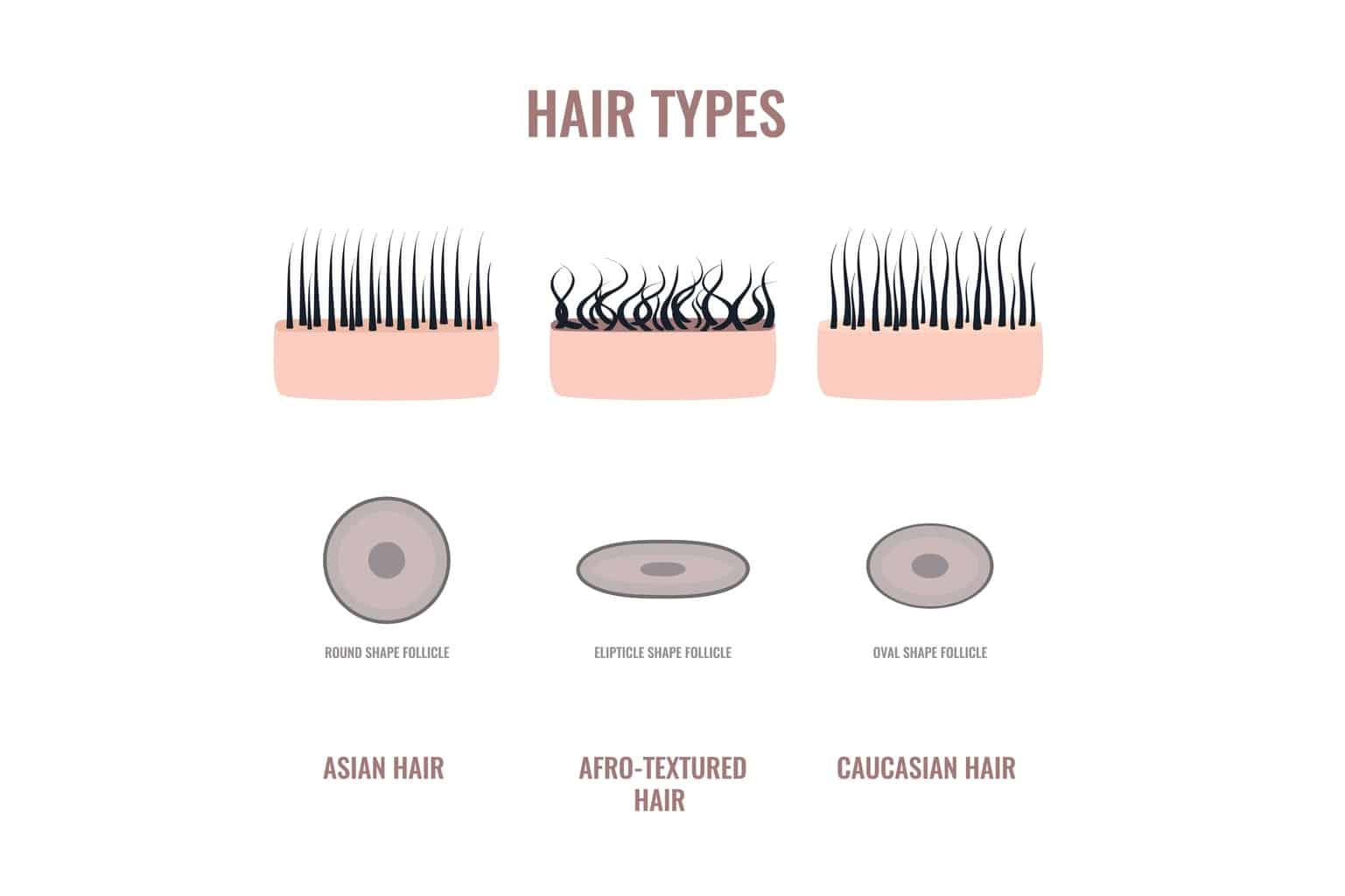
The Asian hair shape is usually straighter because the strand is more often round in cross-section and grows in a more uniform shape. That balanced structure helps the hair fall smoothly and evenly.
Caucasian hair shows more variation in strand shape, ranging from round to oval. The difference creates a wider mix of textures, from straight to soft waves to defined curls.
Pigmentation

Asian hair is typically darker because it contains higher concentrations of eumelanin, the pigment responsible for black and deep brown shades. This high level of pigment gives the hair its characteristically rich, dark color.
Caucasian hair usually contains lower levels of eumelanin and shows a much broader natural color range, from deep brown and blonde to vibrant red. This variation is shaped by the balance between eumelanin and pheomelanin, the pigment responsible for red and yellow tones.
There is also a difference in the aging process. Asians typically begin to gray later than Caucasians. On average, Caucasians start graying in their mid-30s, while Asians often begin in their late 30s or early 40s.
Hair Growth Rate
Asian hair grows faster on average than Caucasian hair. The average growth rate for Asian hair is approximately 1.23 cm per month, while Caucasian hair grows at a slightly slower average of 1.1 cm per month.
That is a difference in group averages, not a prediction for any one person. An individual’s actual growth rate is still heavily influenced by age, genetics, hormones, and overall health.
Moisture Retention
Hydration refers to how much moisture the hair holds, while lipid content refers to the natural oils associated with the hair fiber.
Caucasian hair holds more moisture, while Asian hair typically retains less, a difference shaped by its surface lipids and thicker strand structure.
Strength and Integrity
Asian hair is generally more resistant to snapping and mechanical damage, while Caucasian hair, which is often finer and more oval in shape, can be more variable in its resilience. This helps explain why Asian hair often stays smooth and sleek even as it grows longer.
Editor’s Note: To maintain the highest editorial standards, the ethnic hair diameter, density, and growth rates cited in this article are sourced directly from peer-reviewed literature, including the National Center for Biotechnology Information (NCBI), the Wiley Online Library, Clinical, Cosmetic and Investigational Dermatology (Taylor & Francis), and the Journal of Clinical and Aesthetic Dermatology.